From enquiry to line sketch – in hours instead of weeks.
We bring your next project into focus and get it started with AI. For the internal planning of a new production line as well as for the first project sketch on the machine builder’s side, used to prepare a better quotation. For executives, self-employed professionals and SMEs who have tried AI and now want results.
Or call directly: +49 176 7620 4499
The project manager and the client lead. The AI does the legwork.
In the planning of packaging lines, people always make the decisions. What changes is the time in between.

Hours spent on lists and slides
- Correcting Excel lists and aligning columns
- Updating every sub-item in PowerPoint
- Gathering the current status for the next stakeholder meeting
- Reconciling drawing revisions, parts lists and reports by hand
Checking interim results and fine-tuning
- The AI produces the layout, throughput balance, parts list and report
- You check interim results and outcomes
- You fine-tune, the AI updates all the documents
- The next meeting starts with an up-to-date status
The project manager and the client remain in the lead at every step. The AI makes no decision on its own.
AI projects you can try out
Not a concept paper: these tools have been built and are running on powerjo.de. Two of them are test environments that we are continuously developing. We will show you the project pre-planning in a call.
Project pre-planning up to the tender
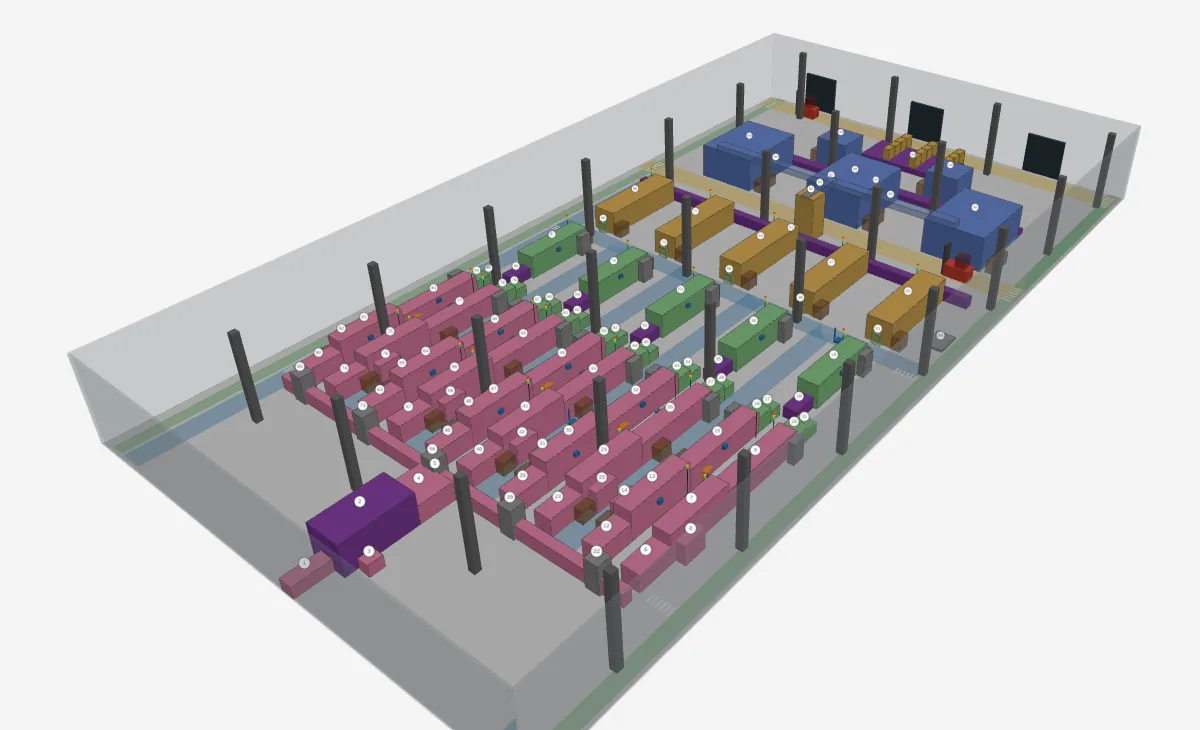
A tender or client conversation becomes a layout, pallet pattern, 3D view and planning report.
- First layout after 45 minutes, complete package after 3 hours
- Throughput balance with downtime analysis and parts list
- Checked by a second AI agent
End-of-line packaging advisor
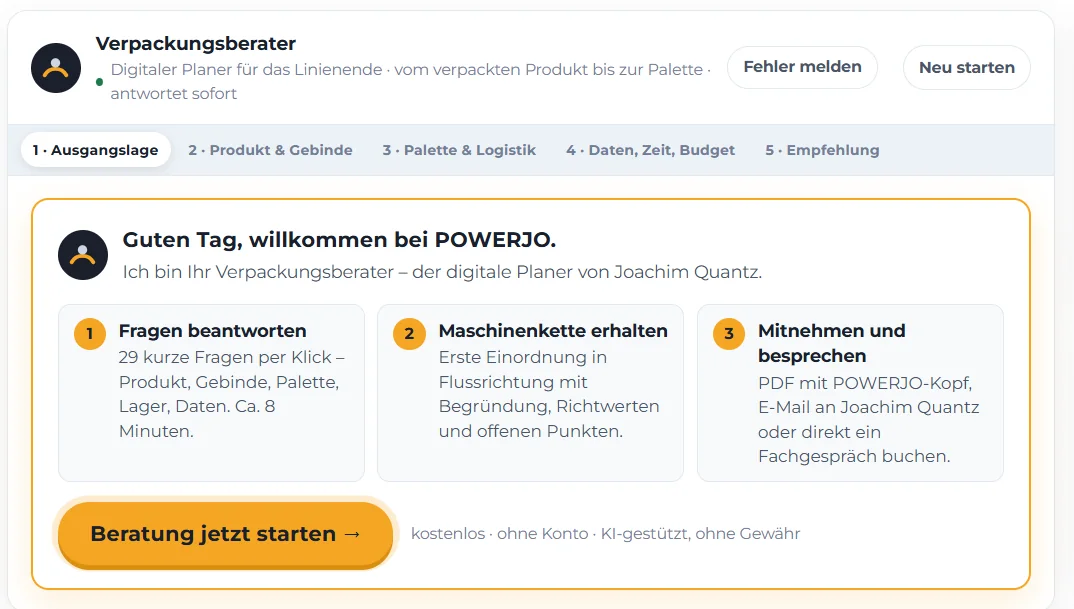
A guided conversation from the packaged product to the pallet.
- 29 short click-through questions, approx. 8 minutes
- Machine chain with reasoning, guide values and open points
- PDF to take away, free of charge and without an account
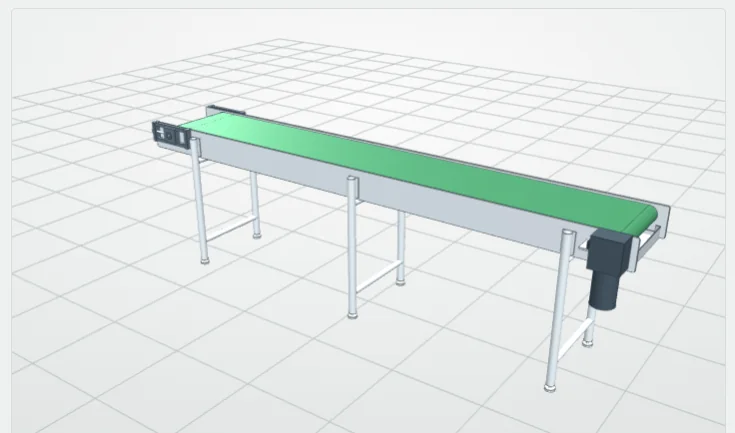
verpackung.tech: Conveyor configurator
Configure conveyors online and see the result immediately.
- 3D model that can be rotated in the browser
- Data sheet, parts list and detail drawings
- For belt conveyors and round-belt conveyors
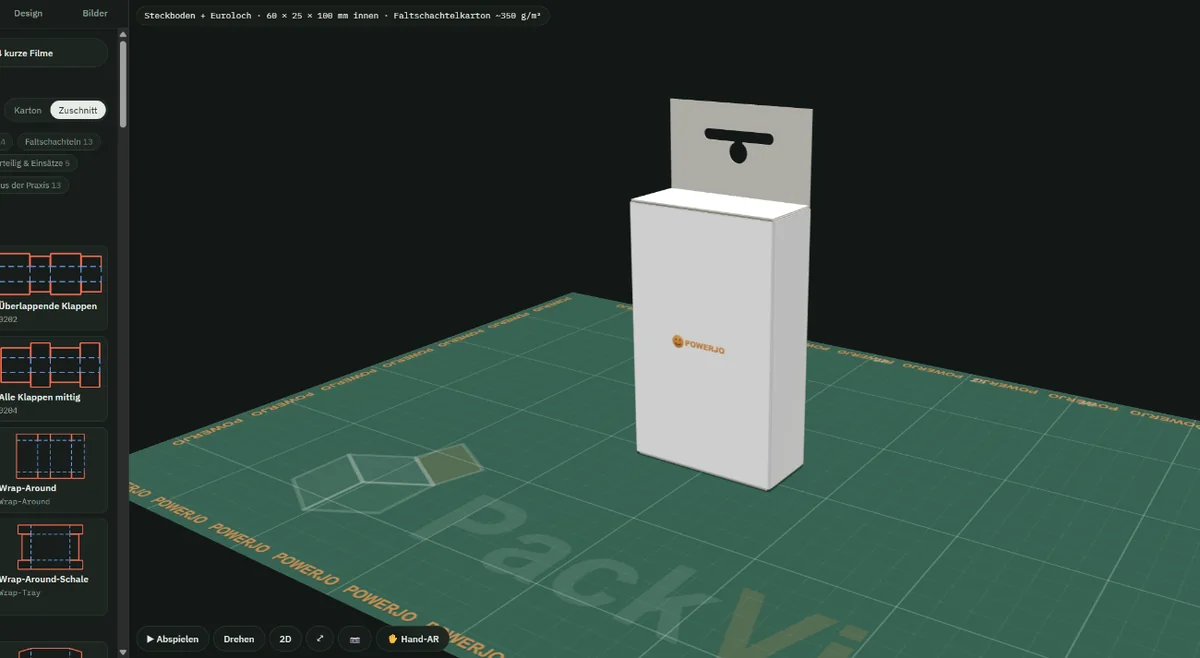
PackVis: design and fold packaging
Design, fold and style folding cartons and corrugated boxes on screen.
- 67 styles, including boxes to FEFCO code
- Folding simulation from the flat blank to the finished box
- Your own designs on the blank, controlled by hand gestures via the camera
How an AI pre-planning works: as a control loop
The AI never works alone. The project manager, plant manager, production manager or managing director is involved in parallel at every step, checks the interim result and sends it back as often as needed until the result fits.
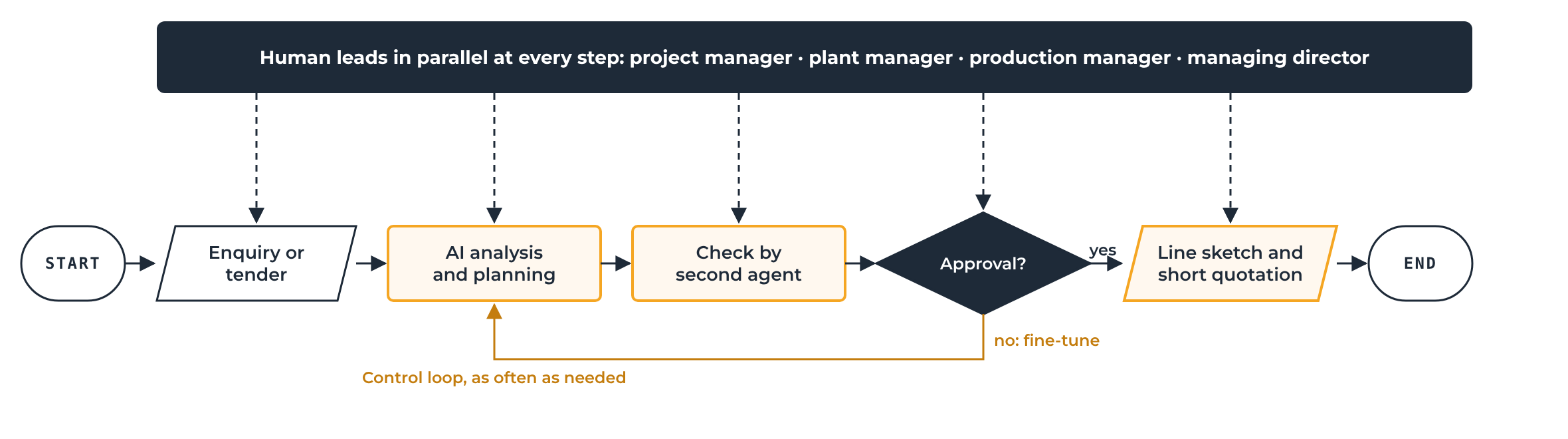
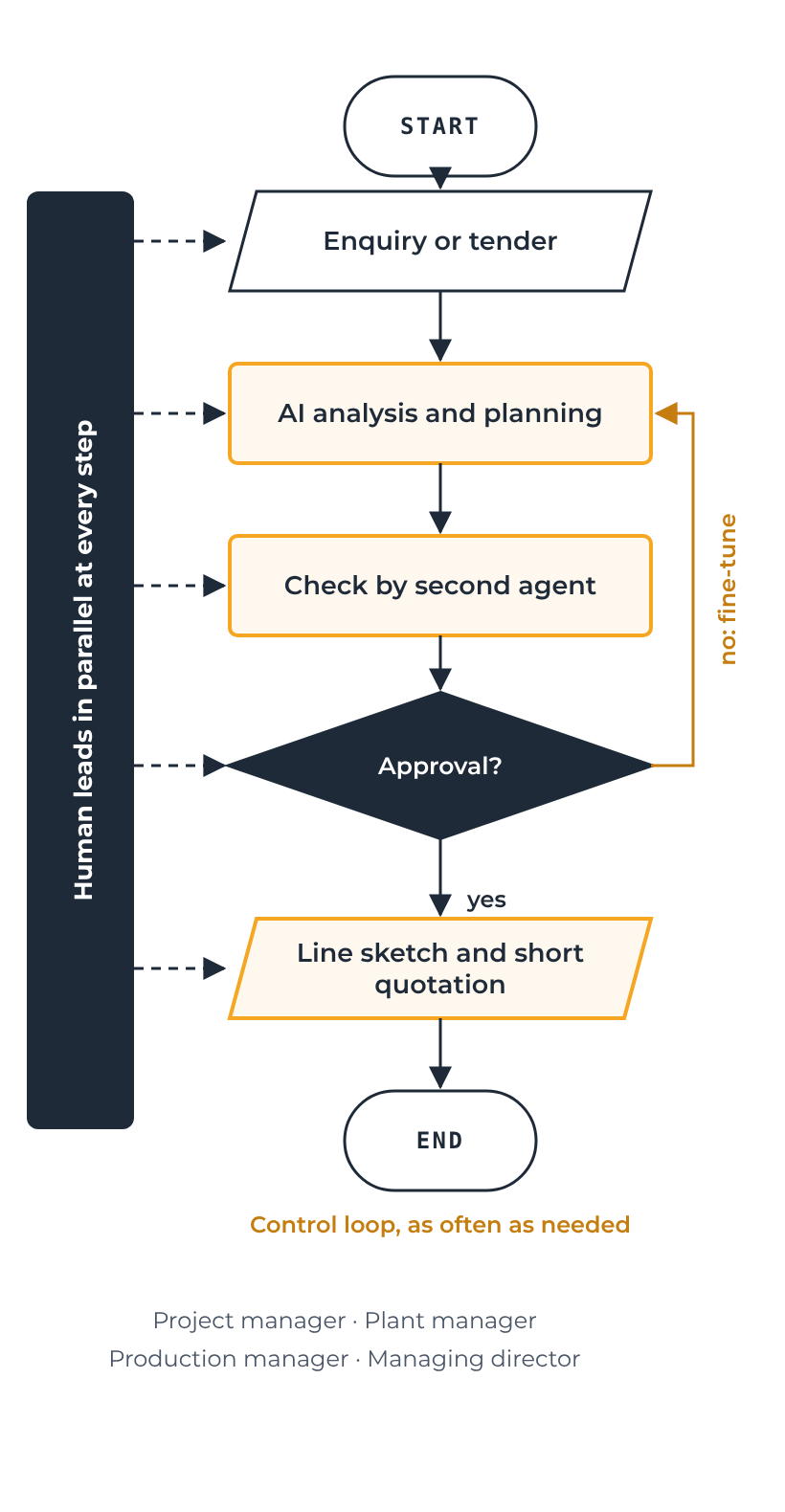
 STEP 1
Input
A project request from management, a tender or a client conversation, exactly as it reaches you. Goal: to know quickly whether it is feasible and how much space and resources are needed.
STEP 2Control loop
The AI extracts requirements, throughput, packaging materials and boundary data and plans. A second agent checks. You approve or fine-tune, then the loop runs again.
 STEP 3
Result
Line sketch and short quotation, ready for coordination with your client or your management. Runs without training on your data; ideally trained internally with your data.
Five lines from pre-planning
All examples are brand-free. Two are anonymised; there the product and key figures have been changed. They are pre-plans, and assumptions are marked.
Biscuit tray line: 10,000 biscuits/min
Biscuits arrive from production and cannot be stopped. 3 × 3 in a three-compartment tray, flow pack, folding carton, 12 per case.
- 1,307 packs/min design capacity, 29.2 pallets/h
- 5 modules with 2 lanes each, central palletising overhead
- N+1 redundancy for lanes, packers and palletisers
Pre-planning V0.1 · hall and performance figures are assumptions
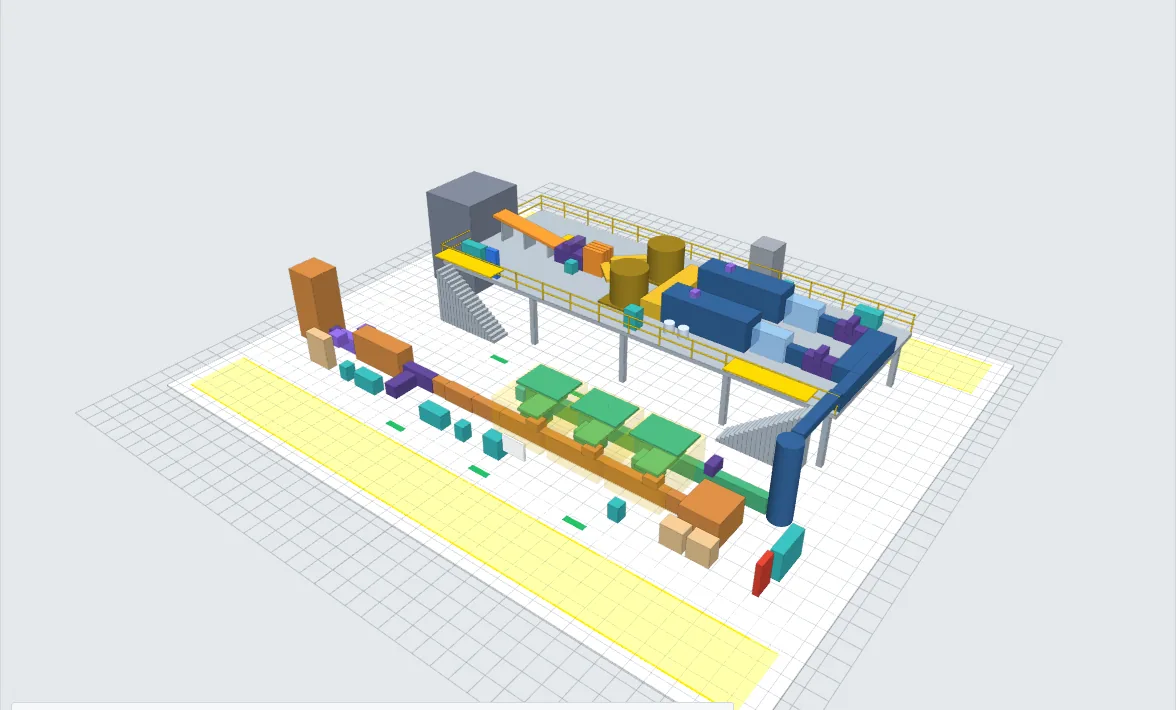
Flatbread line: 9,600 pieces/h
The upstream production must never stop. Stack flat products, pack in flow-wrap bags, pack into cases.
- Stack forming before packaging, with a buffer for disruptions
- Flow wrappers with redundancy, case packing line with manual station
- Open: buffer test with the original product
Pre-planning V0.1 · anonymised: product and key figures changed
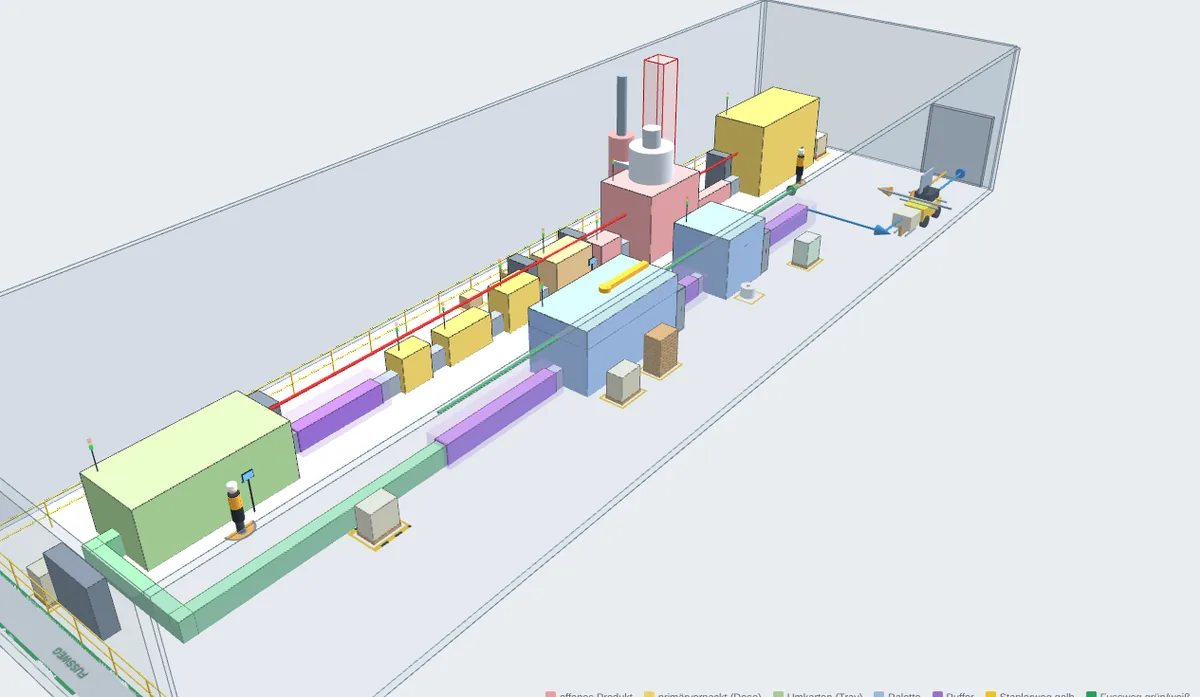
Tin line: 100 tins/min
Sweets in metal tins, 115 tins/min design capacity, empty tins arrive palletised.
- Fully automatic depalletising, multihead weigher for filling
- Pallet pattern: 33 trays per layer, 14 layers
- U-shaped layout in a hall of about 50 × 15 m
Pre-planning V0.1 · hall dimensions estimated
Fruit gum bagging line: 2.35 t/h
2.0 t/h net reliably onto the pallet. Bags of 200 g, in future 120 to 300 g.
- Two lanes with multihead weigher, 98 bags/min each at 77 % load
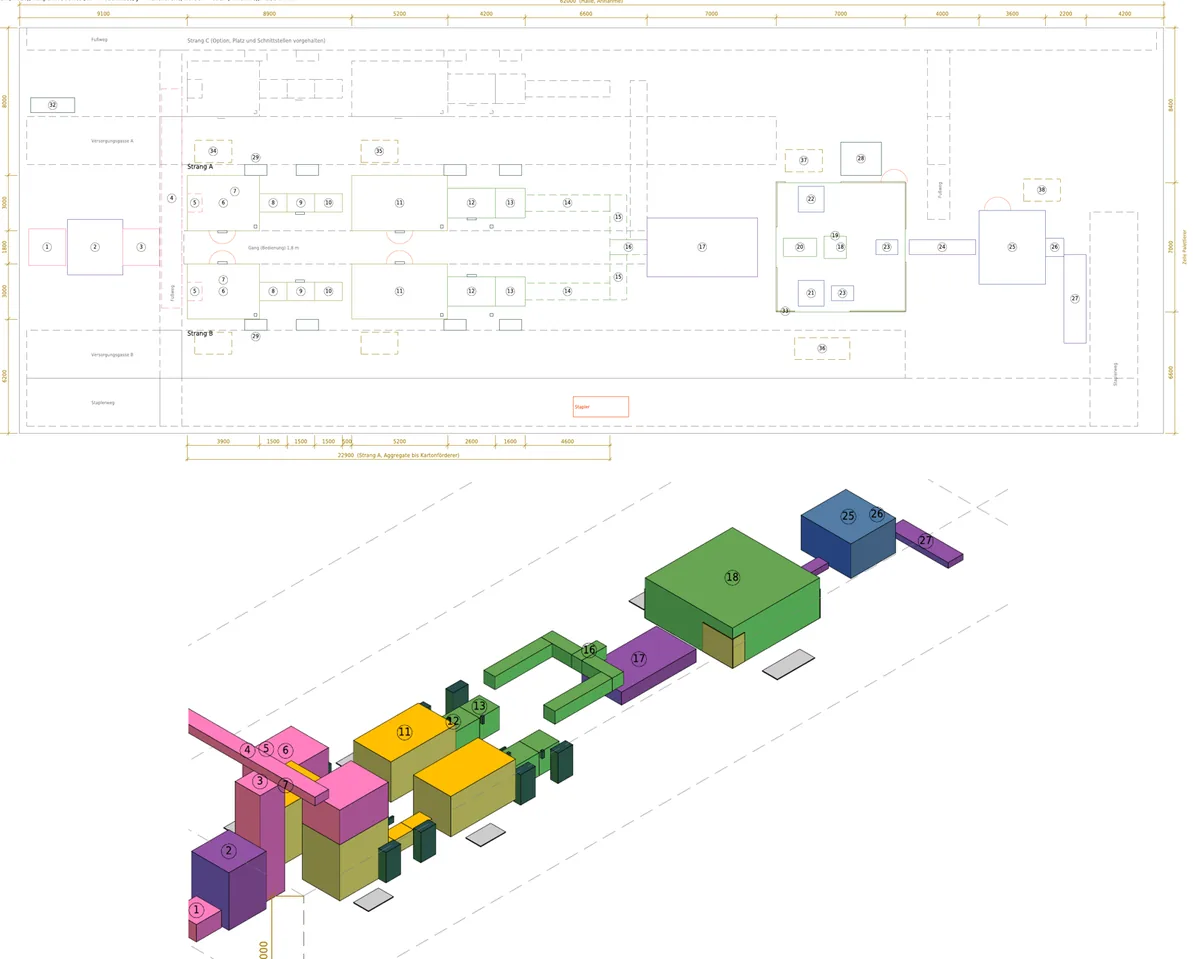
- CAD sheet A1: layout 1:100, isometric view, parts list with 39 items
Pre-planning V0.1 · hall and continuous output of the weigher are assumptions
Capsule line: 600 capsules/min
- One packaging machine carries the design capacity
- Second lane as an option in case of failure
Pre-planning V0.1 · anonymised: product and key figures changed
What your project department has in hand
A pre-planning V0.1 that lets you decide early: Is the line feasible, how much space does it need, where are the risks, and what do we ask suppliers for?
- Throughput balance
- Design capacity with availability, utilisation per machine and what remains if one lane fails.
- Layout
- Hall layout 1:100 and isometric view as CAD sheet A1, with parts list.
- 3D view
- In the browser, to click through with your client. Hygiene zones, buffers and routes are colour-coded.
- Pallet pattern
- Layers, cases per pallet and pallets per hour.
- Planning report
- Assumptions, candidate manufacturers and evidence status per element, plus the open points.
- Regulatory matters
- Where it affects the project, as a separate chapter, for example the EU Packaging Regulation PPWR.
The tender or your meeting notes, product and packaging materials, the required throughput and, if available, the hall dimensions. Anything missing is marked as an assumption and not quietly invented.
First the functions and the process flow, then machines and conveyor technology. A second AI agent checks the package; open points are clearly visible in the report.
A pre-planning does not replace detailed design or approval. It is the basis for deciding quickly and with good reasons and for making targeted enquiries.
- Assess tenders before your team puts days into them
- Quotations with a line sketch instead of a plain text description
- Compare variants, for example with or without an additional lane
- Supplier enquiries based on the parts list and candidate manufacturers
- Align with the client on the 3D view instead of on drawing revisions
- Make risks such as missing redundancy visible early
Working with AI on your project
Live with your team: the AI takes on the legwork, you decide. Choose the depth: one day for the first idea, three days for first models, five days including follow-up work.
1 day
- find a pilot project together
- first ideas and a first example model
- ideas recorded for further use
- on site or by video conference
3 days
- think through a project of your choice
- first models and prototypes for it
- on site including accommodation and travel there and back
5 days: 3 + 2 follow-up work
- everything from the 3-day workshop
- two days of follow-up work: one model or prototype developed further
- on site including accommodation and travel there and back
Each day has two sides: AI on one, creative discussion and building prototypes on the other.
Day 1Understand
Day 2Develop
Day 3Check and define
Follow-up work
We develop one model or prototype further, with:
- Documentation
- Description
- Versioning
No clearly defined project yet? Then start with the Impulse day (Package 1): together we find a pilot project.
Request an Impulse day* All prices plus statutory VAT.
Joachim Quantz
Managing Director of POWERJO GmbH
- Around 40 years in special-purpose machinery and packaging technology
- From technical draughtsman via design engineering to CAPEX project management
- Managed projects from €500,000 to €20 million
- POWERJO since 2017, network of more than 60 on-demand specialists
Let’s talk about your next project.
30 to 60 minutes by video or telephone. You describe your project, we tell you where AI helps, where it does not, and what the next step would be.